

You know what you want to do. You may even know that doing it will be good for you.
But somehow, you don’t start.
Perhaps you tell yourself you’ll do it this afternoon or tomorrow. You decide you need to think about it a little more. You suddenly remember three other things that need doing. Or you pick up your phone for five minutes and, before you know it, an hour has disappeared.
Then comes another thought:
Why can’t I just get on with it?
Or perhaps:
Why do I procrastinate even when I want to do something?
Why do I keep putting things off until the last minute?
Why do I start overthinking instead of doing?
Am I just lazy?
Sound familiar?
Procrastination is something most of us experience. And while better organisation can sometimes help, procrastination isn’t always a time-management problem or because we are lazy.
Sometimes the more useful question is not “How can I make myself do this?” but “What is making this difficult for me to start?”
Procrastination doesn’t mean you are lazy
Procrastination means delaying something you intend to do even though you know putting it off may make things more difficult later. It could be something relatively small like replying to an email, making a phone call, doing some paperwork or sorting something out around the house. Or it could be something much bigger like starting a project, applying for a new job, making a decision, changing a habit or taking the first step towards something you really want.
When this keeps happening, it’s easy to start labelling yourself.
- I’m lazy.
- I have no motivation.
- I’m just not organised enough.
But you can genuinely want to do something and still find yourself avoiding it. Rather than assuming you need more willpower, it can be useful to look at what’s actually happening. Research suggests procrastination isn’t simply about being lazy or not wanting something enough. A review of procrastination research found that factors such as how unpleasant a task feels, how far away the reward is, our confidence in being able to do it and how easily we’re distracted can all play a part.
What are you actually putting off?
- Perhaps you don’t know where to begin or have the necessary skills
- Maybe the task feels too big
- You might be worried about failing or believing you need to do it perfectly
- Perhaps it’s boring, difficult or frustrating
- You may be waiting until you feel motivated, inspired or ready
- Or maybe you’ve become used to leaving things to the last minute
- You may feel you work better under stress
- The goal may no longer feel important to you
- Is it something you genuinely want or is it something you wanted in the past
- Is it something you feel you should be doing
Procrastination isn’t always telling you the same thing. That’s why understanding your own pattern can be more useful than simply finding another productivity technique.
The short-term relief that keeps the pattern going
Imagine you have an important task to do. You think about starting it and immediately feel uncomfortable. Perhaps you don’t know where to begin. Maybe you’re worried it won’t be good enough. Or perhaps it simply feels like too much effort today.
So you check your phone instead. You scroll for a few minutes. Watch a video. Answer some messages. And for a moment, you feel better. The task hasn’t disappeared. But the uncomfortable feeling has.
This is one of the reasons procrastination can become such an easy pattern to repeat. Avoiding something uncomfortable can give us an immediate sense of relief, even when we know that putting it off may create more pressure later.
Sometimes, what you’re avoiding isn’t simply the task. It’s how the task makes you feel.
So what is happening in the brain?
Our brains naturally respond to what feels rewarding, uncomfortable or important, both now and in the future. When something feels difficult, uncertain, boring or overwhelming, different parts of the brain are involved in how we respond.
The amygdala is involved in processing emotions and detecting things that may feel threatening or uncomfortable. This doesn’t mean that every task we put off triggers a fight, flight or freeze response, but uncomfortable feelings can make avoiding the task feel more appealing.
The prefrontal cortex helps with planning, decision-making, managing impulses and keeping longer-term goals in mind. So there can be a tension between what feels easier or more rewarding now and something we know will benefit us later.
Dopamine is one of the neurotransmitters involved in motivation, learning and the brain’s reward system. Activities that offer quick and easily available rewards can compete for our attention with tasks where the reward may be further away.
Your phone is a good example. Checking messages, scrolling or watching a video can offer something interesting immediately. Benefits of completing the project may be hours, days or even months away.
This doesn’t mean that procrastination is simply caused by one part of the brain or one brain chemical. It’s more complex than that. But it helps explain how someone can know that something is important, genuinely want to do it — and still find themselves putting it off.
Sometimes procrastination looks surprisingly productive
Procrastination doesn’t always mean sitting on the sofa doing nothing. Sometimes it looks like this –
- Researching.
- Planning.
- Making another list.
- Watching another video about how to do it.
- Looking for more information.
- Reconsidering your options.
- Thinking about every possible outcome.
- Waiting until you’re completely sure.
All of these things can be useful. But sometimes they become another way to not begin.
This is particularly easy when procrastination and overthinking start working together. You think because you want clarity. Then you question your thinking. Then you think some more. Eventually, taking action feels even harder than it did at the beginning.
When you notice this happening, ask yourself – Do I genuinely need more information, or do I need to just take the next step?
If you notice that you’re procrastinating, try not to immediately criticise yourself or force yourself to “just get on with it”. Instead ask What is making this difficult to start?
Your answer can tell you much more about what might help.
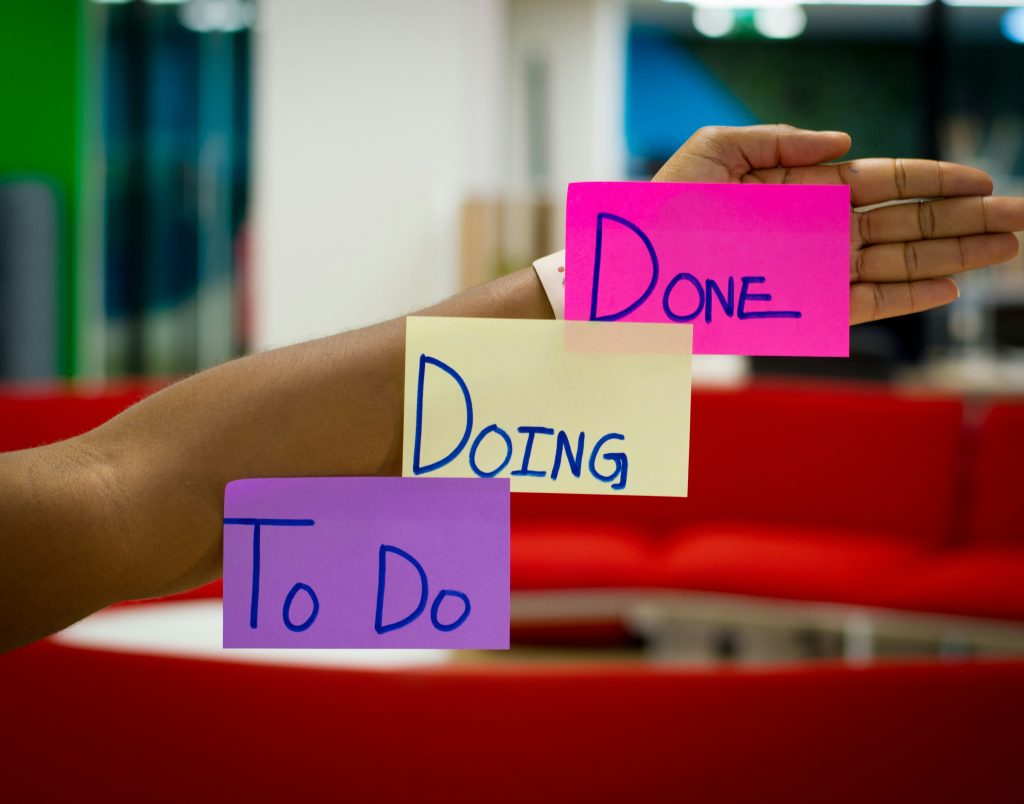
Ways overcome Procrastination
Create a task list of the action steps you need to take.
Breaking down the steps and writing them down is useful. Then having the sense of satisfaction as you cross them off when they are done. And at the end of the day and the week you can see how many actions you have taken.
Make the first step smaller.
If it feels too big , make the first step smaller. for example, instead of “I need to write the report,” consider the task as “I’ll open the document and write a page.”
Give yourself a set amount of time
Set yourself time. In the report example instead of setting the task as “writing the report”, consider I will write a page in the next 20 minutes
Decide where to start
If you don’t know where to start forget the whole task for a moment. What is the very first thing that needs to happen?
Don’t wait for motivation
Sometimes action creates motivation rather than motivation creating action.
Take regular breaks
Set a time to focus and time for breaks. Take a break and move away from the task. Physically move away from the task and have a break. In the break time give yourself a reward, it could be a walk, a hot drink, check your phone.
Let the first attempt be good enough
Ask what ‘good enough to begin’ looks like. The first step is not the final version.
Notice when you’re overthinking
If you’re overthinking: Ask – Do I need to think about this more, or do I already know enough to take the next step.?
Make distractions harder to reach
Put the phone somewhere else. Turn off notifications. Close the tabs you don’t need. Give yourself a defined period of time to concentrate on one thing.
Take a moment to reset
If your mind is busy or you’re feeling overwhelmed, trying to force yourself to get started may not always help. Take a few minutes to journal, meditate, focus on your breathing or simply sit quietly. Creating a little space can help you feel calmer and more centred and ready to decide the next step,
Notice how you’re talking to yourself
If you are criticising yourself, notice the language you are using. There’s a big difference between “Why am I so lazy?” and “What’s making this difficult, and what would make it easier to begin?” One closes down possibilities. The other gives you something to work with.
You don’t have to feel ready to begin
Procrastination isn’t always about a lack of motivation or willpower. Sometimes the task feels too big, unclear or uncomfortable. Sometimes you’re overthinking it, worried about getting it wrong or simply finding it difficult to begin.
Understanding what is behind your procrastination can help you change how you respond to it.
So, rather than waiting until you feel ready, ask yourself:
What is one small step I can take now?
Taking that first step can create the momentum to keep going.
If procrastination, overthinking or self-doubt is becoming a pattern and getting in the way of the changes you want to make, you don’t have to work through it on your own.
Ready to make a change? Book a Discovery Call and we can talk about what you’d like to be different and what may be getting in the way.