


Am I grieving normally?
Why grief can follow different kinds of loss and why it can feel different from one day, or even one moment, to the next.
What is grief ?
Grief is a natural emotional, psychological, physical and social response to losing someone or something deeply meaningful.
Although we often associate grief with death, grief can also follow other significant losses — the end of a relationship, infertility, a change in health, the loss of a job, moving away from home, losing a beloved pet, or another change that alters the life you knew or expected.
When someone important to us dies, we experience bereavement – the loss itself and grief – our response to that loss. But whatever the loss, grief can be confusing.
You may feel overwhelmed one day and surprisingly okay the next. You might feel sadness, anger, guilt, relief or numbness. You may struggle to concentrate or sleep, feel physically exhausted, or find yourself laughing at something and then wonder whether you should.
You may be grieving not only whom you have lost, but also familiar routines, the life you lived, a role you held, a sense of security, part of your identity, or a future you had already imagined.
With so much changing — sometimes from one hour to the next — it is understandable to wonder: Am I grieving normally?.
Why can grief feel so unpredictable?
Grief can affect almost every part of your life. It affects how you think, how you feel physically, your relationships and even your sense of who you are.
It is not only an emotional experience. Your brain and body are also responding to a significant loss and adapting to a life that may now look very different.
In the early stages, grief can feel all-consuming. Later, you may begin to regain some sense of balance, only to find that the sadness, anger, fear or longing suddenly feels intense again.
Even our emotions can seem contradictory.
I remember the first time I laughed after someone important to me had died. Alongside the laughter came guilt and confusion. How could I laugh when I was grieving?
Yet both emotions could exist at the same time.
Grief may include:
- sadness, yearning, anger, guilt, relief, numbness or rapidly changing emotions
- shock or a sense that what has happened is unreal
- difficulty concentrating, remembering or making decisions
- changes in sleep or appetite
- fatigue and reduced motivation
- heightened sensitivity or anxious feelings
- physical sensations or pain
- changes in identity, roles and everyday routines
- changes in how you imagine your future
- moments of laughter, interest or enjoyment alongside grief
You may experience some of these, many of them, or something different. You may experience many of them many times in a day or part of a day. Different losses and different relationships to what has been lost can create very different experiences of grief.
Why can I feel okay one minute and overwhelmed the next?
Grief does not necessarily move in one direction.
Sometimes something inside us brings the loss closer — a thought, a memory, a worry about the future, or remembering the life we had expected.
At other times, something around us can trigger a response. A smell. A song. A photograph. A particular date. A place. A familiar routine.
Sometimes a reminder brings a smile. At other times, the same reminder can bring an intense feeling of loss.
The Dual Process Model of grief, developed by Margaret Stroebe and Henk Schut, offers one way of understanding why this can happen.
Rather than suggesting that we steadily move through grief towards an end point, the model proposes that we naturally move between focusing on the loss and focusing on adapting to everyday life.
At times, your attention may be drawn towards what has been lost — a person, relationship, ability, role, way of life, or the plans and future you had imagined.
At other times, your attention may move towards living — dealing with practical things, developing different routines, connecting with people, solving problems and gradually finding ways to live in changed circumstances.
We can move backwards and forwards between the two.
You might have a day when you feel you are beginning to pull things together and then suddenly find yourself overwhelmed again. That can be confusing and even frightening when you thought you were moving forward. But feeling the loss strongly again does not necessarily mean you have gone backwards
What is happening in my brain and body when I grieve?
Grief isn’t only an emotional experience. A significant loss can affect how we feel physically, how we respond emotionally and how clearly we are able to think.
One way of making sense of this is to think about three different responses happening within the brain and body.
These aren’t three separate parts of the brain working independently — our brain works through interconnected systems — but thinking about them in this way can help explain some of the experiences of grief.
The survival response — safety and threat
At a survival level, significant loss can disrupt our sense of safety and predictability.
Our brain and nervous system are continually responding to what is happening around us. When something important changes, our stress response may become more active as our brain and body try to adjust.
This can contribute to feeling anxious or unsettled, being more easily startled, changes in sleep or appetite, physical tension, tiredness and sometimes feeling less able to cope with things we would normally manage.
This is one reason grief can feel so physical. We aren’t only thinking about what has happened. Our body can be responding to it too.
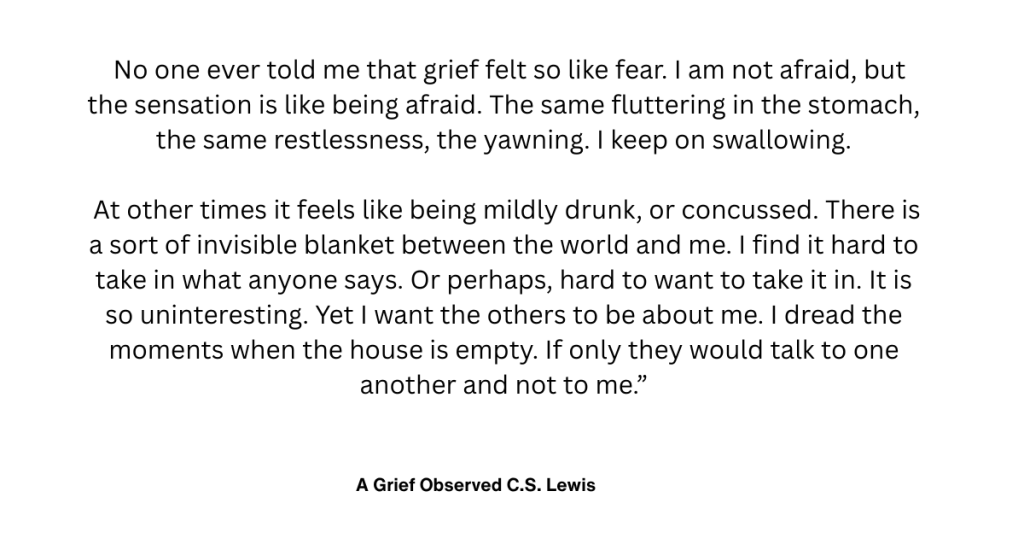
C. S. Lewis captured something of this experience when he wrote: “No one ever told me that grief felt so like fear.”
The emotional response — attachment, memory and loss
At an emotional level, our brain is responding to the loss of something that has become meaningful and familiar.
Throughout our lives we form attachments and associations. People, relationships,places, routines and experiences become connected with memories, emotions and expectations.
When something significant changes, those established patterns don’t simply disappear.
This can also help explain why grief can sometimes seem to come in waves. You may be getting on with your day when a song, a smell, a photograph, a familiar place or even a passing thought suddenly brings the loss much closer again.
Our memories are connected with emotions, senses, people and places. A reminder can activate those associations very quickly, sometimes before we have consciously thought about why we are reacting.
The intensity of the feeling can seem to come from nowhere, even when there was a trigger. And sometimes there may be no obvious trigger at all.
A sudden wave of grief doesn’t necessarily mean you have gone backwards or that you were coping better before and are no longer coping. It can simply be part of the way memories, emotions and attachment continue to respond to loss.
This can also help explain why part of us may understand what has happened while another part still seems to expect life to be as it was.
The thinking response — concentration, memory and decisions
Then there are the systems we rely on for thinking, concentrating, remembering, planning and making decisions. Grief can place additional demands on these abilities.
You may find yourself forgetting why you walked into a room, losing your train of thought, struggling to concentrate, reading something several times without taking it in, forgetting appointments or everyday things, finding decisions unusually difficult and/or feeling mentally slower or less organised than usual. This is sometimes described as “grief brain”.
It doesn’t necessarily mean that something is wrong with your brain. Your attention is being pulled in many directions while you are also dealing with emotion, stress, changes in sleep and the practical consequences of your loss. Things that once required very little thought may temporarily take much more effort.
All three can be happening together
This is perhaps what makes grief so difficult to describe.
You can understand intellectually what has happened while emotionally still yearning for what you have lost and physically feeling unsettled or on alert.
Your thoughts, emotions and body aren’t responding separately. They influence one another. So you can know that someone has died and still expect them to walk through the door.
Grief isn’t simply about understanding a loss. Your brain and body are gradually adapting to what that loss means for the life you are living now.

Why does part of me still expect life to be as it was?
Our brains are continually learning what to expect from the world around us.
When someone has been an important part of your life, your brain has spent months, years or decades learning their presence. You recognise their voice. You know where they usually sit. You anticipate what they might say. You expect them to answer the phone or walk through the door.
Most of this happens without you consciously thinking about it.
When someone dies, you can understand what has happened and still have moments when another part of you expects them to be there. You might reach for your phone to tell them something, think you have seen them in a crowd, or hear a familiar sound and expect them to appear.
For a moment, your old expectation and your new reality meet.
The same principle can apply to other significant losses. After a relationship ends, you may automatically think about telling that person something. After losing a job, you may wake expecting to follow the routine you have followed for years. A change in health may mean your mind still plans around things your body used to do without thought.
Your brain has learned a familiar life. When that life changes, those expectations do not simply disappear.
Part of adapting to loss is gradually learning the reality of a world that is now different from the one you had learned to expect.
What about the Five Stages of Grief?
The Five Stages of Grief is probably one of the best-known models associated with grief.
Elisabeth Kübler-Ross introduced denial, anger, bargaining, depression and acceptance in her 1969 book On Death and Dying. Her original work came from her experiences with people who were facing their own deaths, rather than from creating a sequence that every bereaved person should follow.
Yet the stages are sometimes interpreted as a journey from one stage to the next, with acceptance sitting at the end. And seeing them as that can put ourselves and others under extra pressure when the model was not meant for grievers. It can create expectations both for the person grieving and for the people around them.
I remember hearing someone’s sigh of relief when they said I was at the acceptance stage. They wanted me to feel better, and perhaps to believe that I had reached that final stage and the person I had been before the loss had returned. But if they had really heard what I was saying, I had accepted, in that particular moment, that the person I was grieving was not going to walk through the door. That did not mean my grief was finished, or that I had returned to who I was before.
Models can help us put words around our experiences, but grief does not have to follow a set sequence. You can experience acceptance and sadness. Relief and guilt. Hope and loss. You can have a good day followed by a very difficult one. You have not necessarily gone “back to the beginning”.
Does grief get smaller?
When grief feels all-consuming, it is natural to wonder whether it will ever become smaller.
For some people, it may feel as though the grief itself becomes less intense. For others, it can feel more like they gradually learn how to carry it.
Dr Lois Tonkin’s model of “growing around grief” offers another way of looking at this. Imagine your grief as a ball inside a jar. At first, the ball almost fills the jar. There is very little room for anything else. Over time, rather than the ball necessarily becoming smaller, imagine the jar itself becoming larger. Life begins to grow around the grief.
There may be new experiences, relationships, routines, interests, possibilities and moments of happiness. The loss is still part of your life, but it is no longer necessarily taking up all the available space.
This idea can apply beyond bereavement too. Growing around a loss does not mean pretending it did not matter. It can mean gradually creating room for life alongside what has changed.
Moving forward does not have to mean leaving something — or someone — behind.
Personally, I know that the person I am today is, in part, because of the people I have loved and lost. What they gave me, what I learned from them and the memories we created are part of who I am. I don’t have to leave them behind in order to move forward. I carry them with me.

So, am I grieving normally?
We often look for processes and milestones to help us understand where we are and what should happen next. Grief does not always give us that certainty.
A significant loss can change the shape of everyday life. You may be adjusting not only to who or what you have lost, but to changes in your routines, relationships, sense of security, identity or the future you had imagined.
Different losses bring different experiences of grief. Your experience will be influenced by who or what is no longer part of your life in the same way, what that loss means to you, the circumstances surrounding it and the life that continues around you.
That is why comparing your grief with someone else’s can be so difficult.
There can still be enormous comfort in talking to people who have experienced loss. We may never know exactly how another person feels, but recognising something of our own experience in theirs can help us feel less alone and less confused by what we are experiencing.
There is no single way to grieve. You may have days when life feels manageable and others when the loss suddenly feels much closer again.
A difficult day does not mean you have gone backwards. A good day does not mean what you lost no longer matters. And laughing, enjoying something or looking forward to something does not mean you have forgotten.
Grief takes time.
And that in itself can feel uncomfortable.
We often want to know when we will feel better, when things will become easier or when we will start to feel more like ourselves again. Grief does not always give us those answers.
Over time, it may change. Perhaps, as Tonkin’s model suggests, rather than leaving grief behind, we gradually build a life that has room for both what we have lost and what is still to come.
Give yourself the time and space you need to grieve. You do not have to know what comes next. Sometimes getting through today is enough. Sometimes getting through the next 20 minutes is enough.
Needing support does not mean that the way you are grieving is wrong or that grief needs to be fixed.
If grief or another significant loss is affecting how you are thinking, feeling or managing everyday life, you do not have to work everything out on your own.
Sometimes talking can simply give you the space to make sense of what you are experiencing and find your own way forward.